






Suggested release: Tuesday, November 3, 2026
If pain is keeping you from the activities you love, you have probably heard about many treatments - rest, therapy, injections, and surgery. Class IV laser therapy is a powerful, research-backed addition to that plan. It is non-invasive, drug-free, and needle-free, and it can help reduce pain and inflammation so you can move better and get more out of your rehabilitation. It works best alongside an accurate diagnosis and a complete treatment plan.
What is Class IV laser therapy?
Class IV laser therapy, also called high-intensity laser therapy, uses focused red and near-infrared light. The science behind it is called photobiomodulation. In simple terms, light energy is absorbed by the "power plants" inside your cells (the mitochondria), helping them make energy more efficiently, improve local blood flow, and calm inflammation and pain signals.
Class IV lasers are far stronger than older low-level ("cold") lasers - above 500 milliwatts, and in research studies usually around 10 watts. That extra power matters because it lets the light reach deeper structures, such as a shoulder tendon, a knee joint, or the muscles along the spine, rather than only the skin surface. In head-to-head studies, high-intensity lasers have generally relieved pain better than low-level lasers. Protective eyewear is worn during treatment, and there are no cuts, needles, or downtime.
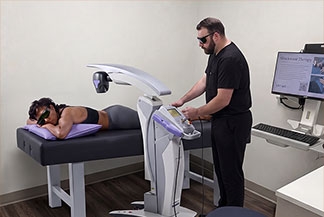
At OrthoMiami, we utilize the Robotic M7 MLS® Therapy Laser, an industry leader with over 20 years of experience in photobiomodulation therapy. The Robotic ULTRA Head scans the specified treatment area evenly, distributing laser energy consistently for efficient, reproducible treatment. A handpiece can also be used to target trigger points and can be used in combination with the Robotic ULTRA Head to treat the same area from a different angle.
What conditions and body areas respond best?
The research is strongest for deep, painful, inflamed joints and soft tissues. Body areas with the most supporting studies include:
- Knee– Especially knee osteoarthritis, the most-studied condition
- Shoulder – Frozen shoulder, rotator cuff tendon pain, impingement, and bursitis.
- Neck and low back– chronic neck pain, low back pain, disc problems, arthritis, and stenosis-related pain
- Elbow, wrist, and hand– tennis elbow, carpal tunnel syndrome, and hand arthritis
- Foot and ankle– plantar fasciitis (heel pain) and Achilles pain
At OrthoMiami, laser therapy is also used during recovery from muscle strains, ligament sprains, cartilage injuries, labrum or rotator cuff tears, and in post-surgical recovery to ease pain and inflammation around the injury.
An important distinction: laser therapy does not sew a torn labrum or rotator cuff back together. A torn tendon or labrum is a mechanical problem, and some tears still need surgical repair. Laser therapy can help with the pain and inflammation around that problem, and it may be used before surgery, after surgery, or in place of surgery when a non-surgical plan is right for that patient. That decision is always individual.
Myths and facts
- Myth: "Laser therapy is just a heat lamp." Fact: The benefit comes from light-driven changes inside cells, not just warmth.
- Myth: "All therapy lasers are the same." Fact: Higher-power Class IV lasers reach deeper tissues and have generally outperformed low-level lasers in comparison studies.
- Myth: "It only masks pain for a day." Fact: Studies show pain relief lasting beyond the treatment course, including at follow-up of 3 months or more.
- Myth: "Laser therapy regrows cartilage or repairs tears." Fact: Some early studies have shown encouraging changes in cartilage and tendons, but this is still being studied. Today, its proven role is reducing pain and improving function.
- Myth: "It replaces exercise." Fact: Results are best when laser therapy is combined with exercise and physical therapy.
What does the research show?
The evidence is strong and growing. A 2023 review of 48 randomized trials found that high-intensity laser therapy reduced pain and improved function, range of motion, and quality of life across musculoskeletal conditions, with the biggest functional gains in the knee and shoulder. A 2024 umbrella review (a review of systematic reviews) found the largest, most meaningful pain improvements in frozen shoulder, knee osteoarthritis, low back pain, and muscle (myofascial) pain. Earlier analyses found clear benefits for neck and back pain.
For knee osteoarthritis, a large 2024 analysis comparing 12 non-drug treatments across 139 trials ranked high-intensity laser second only to water-based exercise for pain relief. A 2026 analysis comparing high- and low-intensity lasers found greater pain relief with high-intensity laser, especially in knee osteoarthritis, carpal tunnel syndrome, tennis elbow, and shoulder conditions.
The largest review to date, published in 2026 and covering 105 studies and more than 5,000 patients, reported large and lasting pain relief, consistent improvements in movement and daily function, and no serious side effects. As with any treatment, results vary by condition, dose, and patient, and researchers continue to refine the ideal treatment settings.
What is a session like, and how long does it take?
Most sessions are short - typically about 5 to 20 minutes per area, depending on the size and depth of the problem. You lie or sit comfortably while the robotic head scans the area, or a handheld device is moved slowly over the skin. Most people feel gentle warmth and no pain. You can usually return to normal activities right away.
A typical course is 6 to 12 sessions, often 2 to 3 times per week at first. Acute injuries may need fewer sessions; long-standing arthritis or chronic tendon pain may need more, or occasional maintenance visits. Your plan is tailored to how you respond.
Who is a good candidate, and who should not have it?
Good candidates include people with:
- Knee, hip, hand, shoulder, or spine arthritis pain
- Tendon, bursa, or muscle pain that has not settled with rest or therapy
- Recovery after sprains, strains, or surgery
- A desire to limit pain medicines or delay or avoid injections or surgery, when appropriate
Laser therapy is not used, or is used only with special care, in these situations:
- Directly at the eyes - never; protective eyewear is always worn
- Over a known or suspected cancer - avoided outside of specialized cancer-care uses
- Over the abdomen or pelvis during pregnancy
- Photosensitivity or light-sensitizing medicines
- Tattoos or very dark skin pigment in the treatment area - settings may be adjusted because these areas can warm up more
- Implanted electronic devices (such as pacemakers or stimulators) - assessed case by case
- Over the thyroid gland
- Light-triggered seizures
Tell your clinician about all of your conditions and medicines before starting.
What are the benefits, and what are the risks?
Possible benefits include less pain, less swelling and inflammation, better range of motion, and a faster return to rehabilitation exercises - without the risks of medicines, injections, or an operation for that part of care.
Risks are minimal when treatment is done correctly. Temporary warmth, mild redness, or tingling can occur, and a small number of people notice brief tiredness or a mild headache. Across more than 100 studies, no serious side effects were reported.
Off-Label and emerging uses
Beyond its cleared uses for muscle and joint pain, laser and light therapy is being used and studied for:
- Nerve pain, including diabetic neuropathy and chemotherapy-related neuropathy
- Lymphedema (swelling after cancer treatment)
- Fibromyalgia
- Wound healing
- Post-surgical pain and swelling
These uses show promise but have less research behind them than the orthopedic uses above.
How does it fit with PRP and other orthobiologics?
Laser therapy is often combined with physical therapy, platelet-rich plasma (PRP), and other orthobiologics. Each has a role: therapy restores strength and movement, PRP or another biologic supports the local healing environment, and laser reduces pain and inflammation so rehabilitation can progress. Studies already show laser works better when combined with exercise. Research on combining laser with PRP specifically is still early, but the combination makes sense in practice.
What does the future hold?
Research is moving quickly. Areas under active study include:
- Tissue healing- early studies have reported thicker knee cartilage and smaller rotator cuff tears after treatment, which larger trials are now testing
- Standardized dosing- matching power, time, and energy to each condition for more predictable results
- Nerve recovery- improved nerve function in neuropathy
- New areas- osteoporosis, cognitive health, and chronic pain conditions
- Larger multicenter trials- to confirm long-term benefits
Is laser therapy a non-surgical option?
For many acute and chronic conditions, yes - it can be a central part of a non-surgical plan. For others, it is a bridge that reduces pain while you complete therapy, wait for a procedure, or recover after surgery. The right question is not "laser or surgery?" but "what is causing this pain, what will fix that cause, and what can safely help along the way?"
If you are considering laser therapy, bring your imaging, your list of prior treatments, and your goals. A good plan starts with the diagnosis - and at OrthoMiami, we have the technology on-site to put that plan into action.
This post is for education only. It is not medical advice, it does not replace an in-person evaluation, and no treatment can promise a cure or a specific result. Talk with your orthopedic surgeon about whether laser therapy fits your diagnosis and your overall plan.